4、 结论
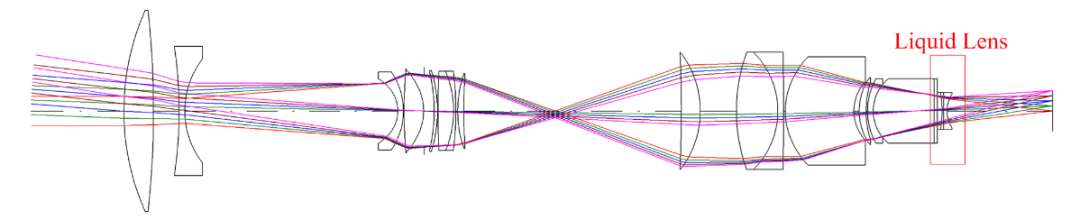
本文确定了具有液体透镜的微型光学器件的最佳光学结构设计以及在消除像差和提高MTF方面最有效的液体透镜组。这种光学结构和透镜组使光学器件设计人员能够进行二次开发,并将其纳入应用程序包,供光学设计从业者使用。这些技术省去了其他试验和调试程序的需要。
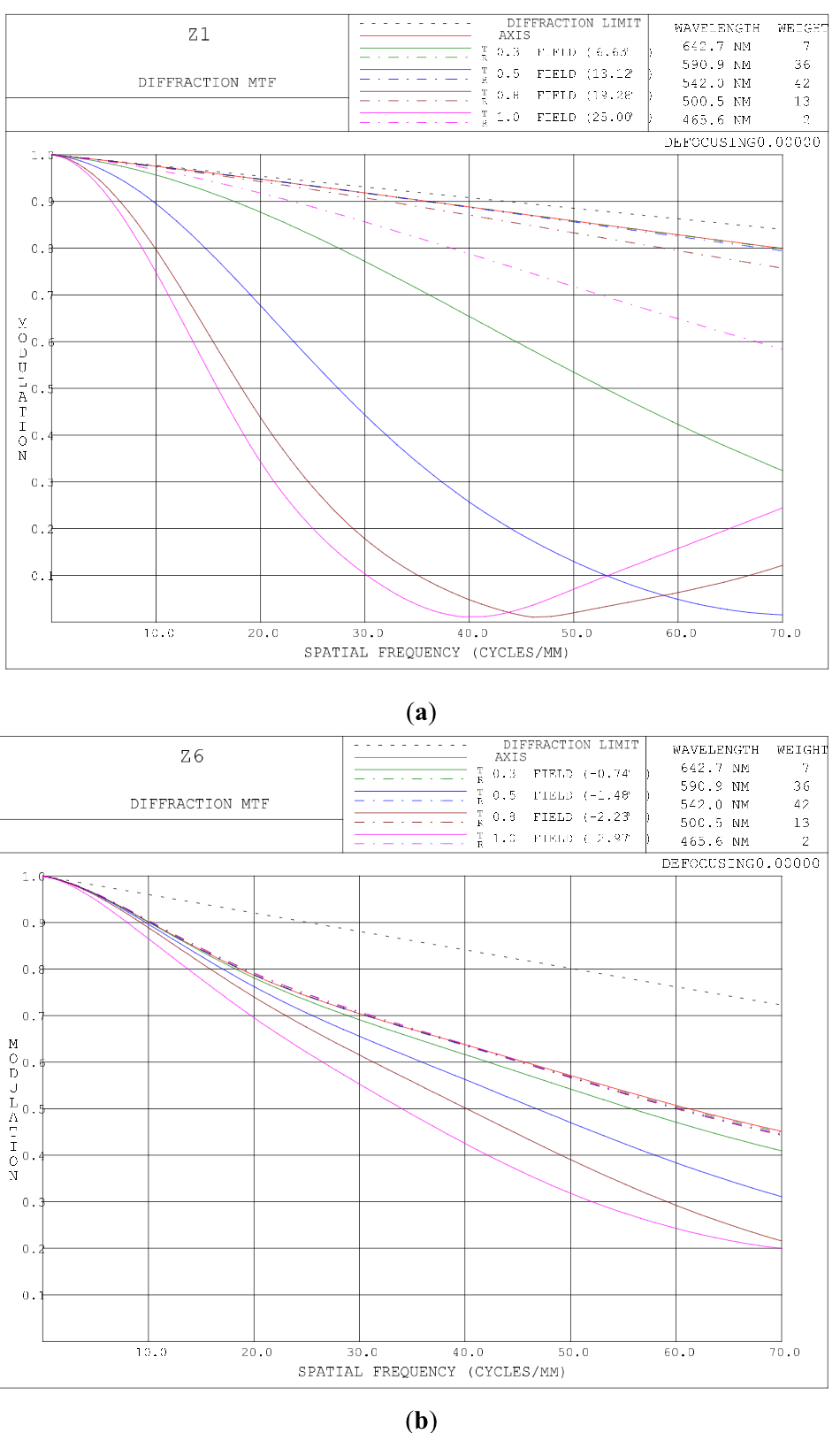
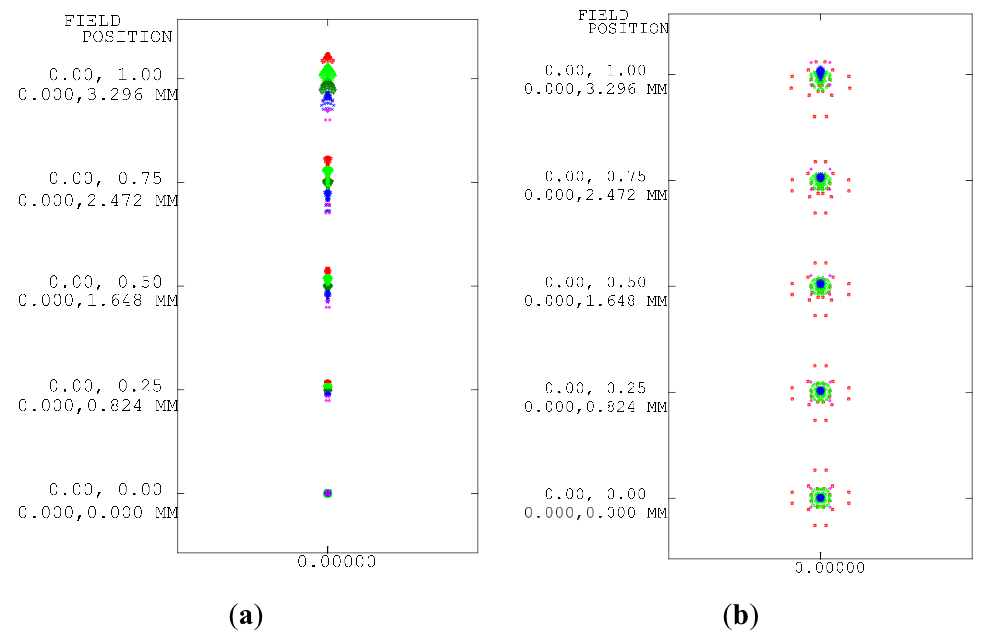
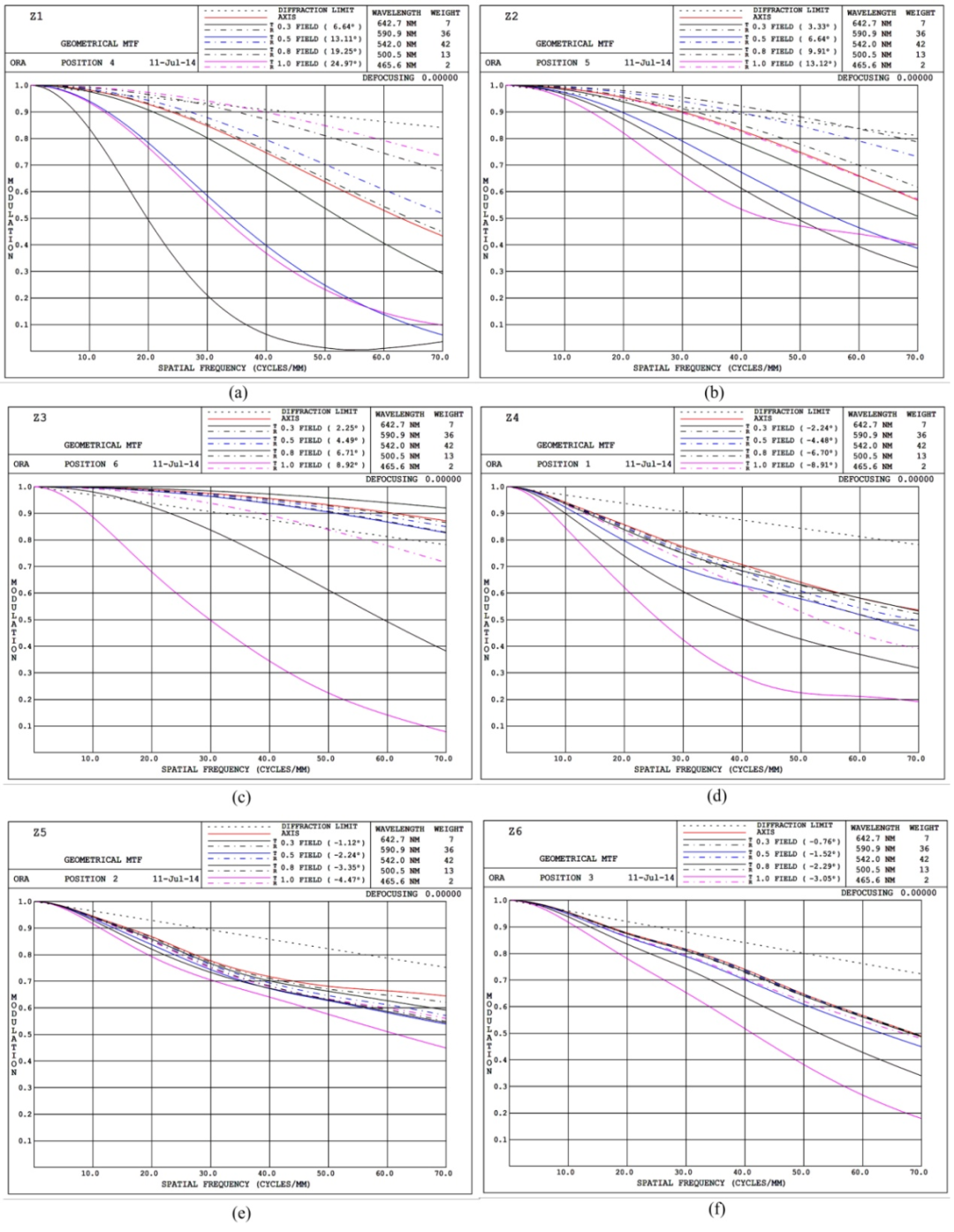
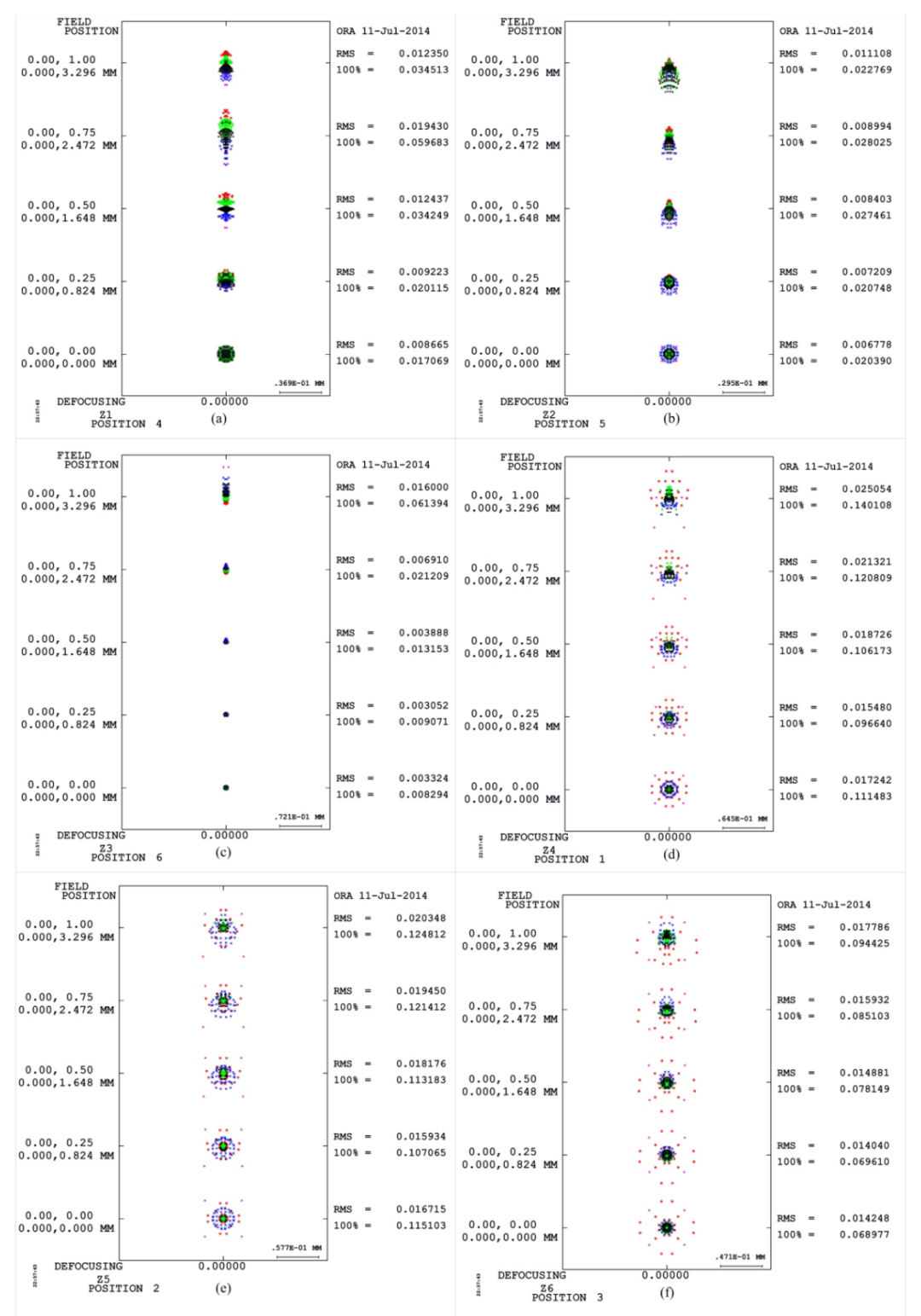
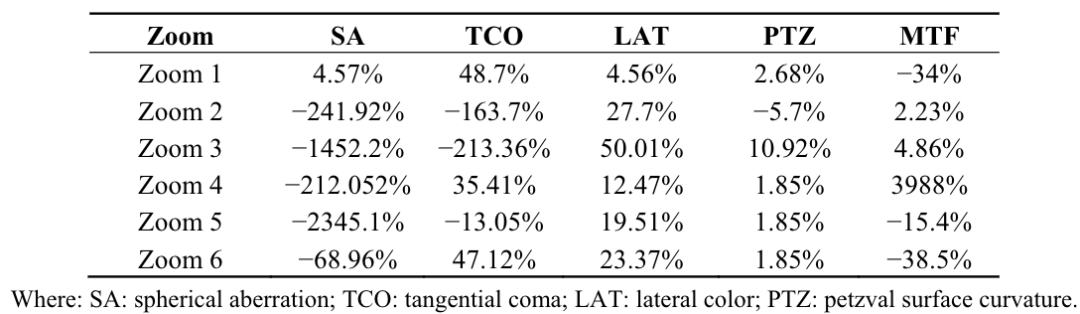
仿真结果表明,与标准的9倍变焦镜头相比,仿真的镜头表现出更好的性能。提出的透镜能尽可能收集边缘光线,从而改善系统性能。与标准的9倍变焦镜头相比,该镜头的球面像差降低了4.57%,切向慧度降低了48.7%,Petzval表面曲率降低了10.92%,侧面色彩降低了50.01%。尤其是在40 1p / mm时,建议的透镜使MTF增加了近3988%。这项研究表明,液体镜片(1)消除了对机构工作以及延迟的需求;(2)在光学设计上提供更大的灵活性和自由度;(3)可以用来代替传统的补偿镜头,并提供比差值变焦更多的状态。
参考文献
1. Valley, P.; Reza Dodge, M.; Schwiegerling, J.; Peyman, G.; Peyghambarian, N. Nonmechanical bifocal zoom telescope. Opt. Lett. 2010, 35, 2582–2584.
2. Akram, M.N.; Asghar, M.H. Step-zoom dual-field-of-view infrared telescope. Appl. Opt. 2003, 42, 2312–2316.
3. Lin, Y.H.; Liu, Y.L.; Su, G.D.J. Optical zoom module based on two deformable mirrors for mobile device applications. Appl. Opt. 2012, 51, 1804–1810.
4. Greisukh, G.I.; Ezhov, E.G.; Kalashnikov, A.V.; Stepanov, S.A. Diffractive-refractive correction units for plastic compact zoom lenses. Appl. Opt. 2012, 51, 4597–4604.
5. Lin, P.D.; Sung, C.K. Comparing two new camera calibration methods with traditional pinhole calibrations. Opt. Express 2007, 15, 3012–3022.
6. Kawakita, M.; Iizuka, K.; Iwama, R.; Takizawa, K.; Kikuchi, H.; Sato, F. Gain-modulated axi-vision camera (high speed high-accuracy depth-mapping camera). Opt. Express 2004, 12, 5336–5344.
7. Seo, S.W.; Han, S.; Seo, J.H.; Kim, Y.M.; Kang, M.S.; Min, N.G.; Choi, W.B.; Sung, M.Y. MEMS-based liquid lens for capsule endoscope. In Proceedings of the SPIE 6931, Nanosensors and Microsensors for Bio-Systems, San Diego, CA, USA, 26 March 2008.
8. Miks, A.; Novák, J.; Novák, P. Method of zoom lens design. Appl. Opt. 2008, 47, 6088–6098.
9. Wick, D.V.; Martinez, T.; Payne, D.M.; Sweatt, W.C.; Restaino, S.R. Active optical zoom system. In Proceedings of the SPIE 5798, Spaceborne Sensors II, 151, Orlando, FL, USA, 22 June 2005;
pp. 151–157.
10. Martinez, T.; Wick, D.V.; Payne, D.M.; Baker, J.T.; Restaino, S.R. Non-mechanical zoom system.
In Proceedings of the SPIE 5234, Sensors, Systems, and Next-Generation Satellites VII, 375, Barcelona, Spain, 2 February 2004; pp. 375–378.
Appl. Sci. 2015, 5 621
11. Johnson, R.B.; Feng, C. Mechanically compensated zoom lenses with a single moving element. Appl. Opt. 1992, 31, 2274–2278.
12. Kienholz, D.F. The design of a zoom lens with a large computer. Appl. Opt. 1970, 9, 1443–1452.
13. Tsai, C.M.; Yen, C.T.; Fang, Y.C.; Chen, C.A. A study of optical design of zoom optics. In Proceedings of the SPIE 8841, Current Developments in Lens Design and Optical Engineering
XIV, 88410I, San Diego, CA, USA, 25 September 2013; p. 88410I.
14. Chapter 5—Feild Lenses. Available online: http://www.sk-advanced.com/category/chapter-5-feild-lenses
(accessed on 15 August 2013).
15. Topic 43: The Field Lens. Available online: Http://www.colorado.edu/physics/phys1230/
phys1230_fa01/topic43.html (accessed on 16 November 2001).
16. Ren, L.; Park, S.; Ren, H.; Yoo, I.S. Adaptive liquid lens by changing aperture.
J. Microelectromech. Syst. 2012, 21, 953–958.
17. Park, J.; Liu, C.X.; Choi, J.W. A planar liquid lens design based on electrowettin. In Proceedings
of the IEEE Sensors, Atlanta, GA, USA, 28–31 October 2007; pp. 439–442.
18. Zhang, W.; Li, D.; Guo, X. Optical design and optimization of a micro zoom system with liquid
lenses. J. Opt. Soc. Korea 2013, 17, 447–453.
19. Fang, Y.C.; Tsai, C.M.; Chung, C.L. A study of optical design and optimization of zoom optics
with liquid lenses through modified genetic algorithm. Opt. Express 2011, 19, 16291–16302.
20. Varioptic, S.A. Optical and Opto-mechanic Data. Available online: http: //www.varioptic.com
(accessed on 2 December 2010).
© 2015 by the authors; licensee MDPI, Basel, Switzerland. This article is an open access article distributed under the terms and conditions of the Creative Commons Attribution license (http://creativecommons.org/licenses/by/4.0/).







![[VirtualLab] 二维叉形光栅产生涡旋光阵列](https://img.optkt.com/dataattach/block/c1/c1250fdddd5aa4d5edc5364120ef1954.jpg)
![[VirtualLab] 产生长焦深Bessel光束的HOE设计](https://img.optkt.com/dataattach/block/21/2199c88436522455cbfda04f86ce32e3.jpg)
![[VirtualLab] 二维叉形光栅产生涡旋光阵列](https://img.optkt.com/dataattach/block/61/61dae81938b04bf9aedf63454a94208c.jpg)